Beyond early adopters: How to start designing AI for the 84%
The AI adoption divide
A reasonable person could easily assume, with all the buzz and hype, that AI has reached widespread adoption. But guess what, that reasonable person is wrong. According to a recent Ipsos poll, almost everyone in the US has dabbled in AI, but just 1 in 10 Americans is using AI often.
What does this mean? It means that AI is at the “the chasm“: The critical inflection point where many technologies fail to transition from early market success to mainstream adoption. According to famed Sociologist, Everett M. Rogers, these early adopters represent only about 16% of a total market, while it’s the other 84% who will ultimately make or break the success.
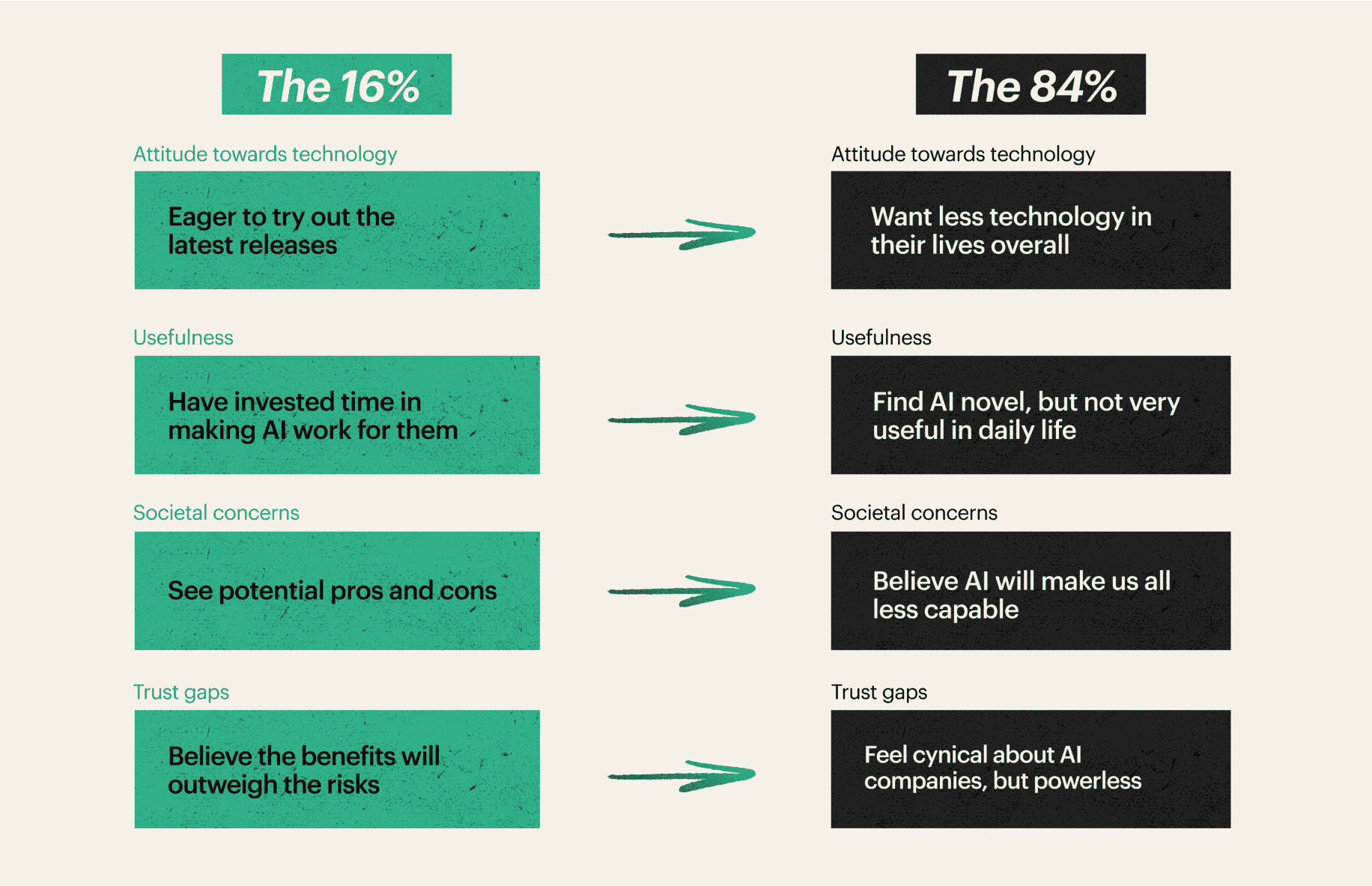
In our recent research studies for companies at the leading edge of AI product development, such as Meta and Google, we have met a diverse range of people and gained valuable insights into how people are adopting emerging technologies. These studies made clear that the mindsets of early adopters differs greatly from the aspirations of everyone else.
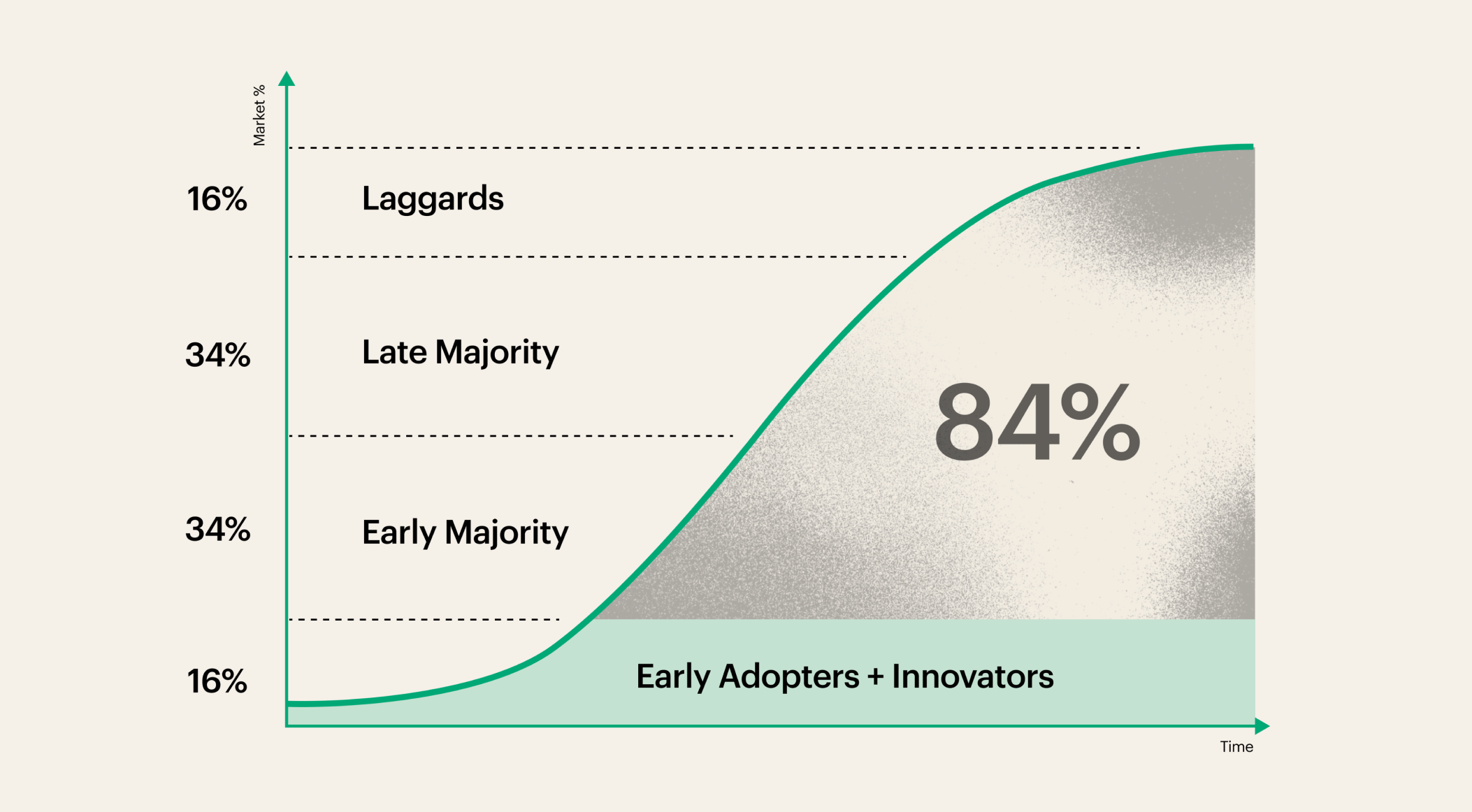
Everett Rogers’ Diffusion of Innovation Theory was developed in 1962; this framework explains how new ideas, products, or technologies spread through society in five distinct adoption stages.
Who are the 84%?
We’ve identified four key differences between the 16% and the 84% when it comes to AI adoption. Which one are you?
Pathways toward the 84%
To get past the chasm, we must lean into what most people want technology experiences to feel like. That means creating technology experiences that feel intuitive, supportive, and aligned with what most people want from the digital tools in their everyday lives.

01 Declutter, don’t add noise
Today’s technologies contribute to technostress, which is the mental strain and discomfort people feel when they struggle to keep pace with evolving technology. Many people feel overwhelmed by a plethora of screens, alerts, devices, and apps that compete for their time and attention. Ironically, AI can be part of the solution, but only if we use it to reduce digital clutter, not add to it.
From Japan’s “calm technology” movement—where tech is designed to stay in the background and only surfaces when truly needed—to AI that curates your home screen and shields you from endless app hopping, designers can create tools that understand context. Even “agentic AI,” which can take direction and perform tasks autonomously, can help offload time-consuming mental clutter.
Design tip:
AI should fade into the background when not needed. It should offer ways for users to spend less time on screen, not just more features.

02 From prompting to kneading
For many in the 84%, interacting with AI feels clunky. They’re simply uninterested in overcoming the barrier of prompt engineering, the art of writing and refining the perfect prompts to get desired outputs.
To use a bread-making metaphor, a prompt can get you all the ingredients in a bowl, but it’s the kneading and hands-on shaping that truly brings the material to life. This is where tacit knowledge, what we know through experience and intuition, becomes essential. Current AI experiences often fall short in supporting this kind of creative, human-led collaboration.
Design tip:
Let people shape what AI gives them. Create tools that engage intuition, not require a new language.

03 Positive friction adds value
In a world obsessed with speed and automation, we often forget that slowing down can create deeper meaning. Positive friction guides people to use AI in ways that challenge and engage, building both knowledge and a sense of accomplishment.
In the current AI landscape, this principle is alive in tools like Khan Academy’s Khanmigo.ai tutor, which encourages active learning rather than simply giving answers. The 84% don’t want to become passive consumers of technology. They want tools that build their skills, not do everything for them.
Design tip:
Don’t remove all friction in the name of efficiency. Thoughtful, purposeful friction can encourage learning, ownership, and delight.

04 Self-explaining systems build trust
The 84% have low levels of trust in technology, driven in part by widespread data breeches, opaque data practices, and business models that drive addiction. Trust in technology is broken and rebuilding it starts with transparency. People want to know what data is being collected, how it’s used, and what control they have.
When people go looking for answers, they’re often met with legal jargon, buried settings, or vague policy pages. Yet, the very companies building large language models, tools designed to make complex information easier to understand, rarely use them to clarify their own products. If applied internally, these tools could help demystify systems, build trust, and ease user hesitation.
Design tip:
Use AI to explain AI. Answer users’ questions proactively and build trust through clarity, not obfuscation.
What designers can do now
This challenge isn’t just one for engineers or product managers, it’s for everyone in design. Here’s what designers can do now to create AI that’s more inclusive, intuitive, and human-centered:
Design outputs, not just inputs
Designers should go beyond the surface, focus should stretch farther than the interface alone. Pay close attention to the outputs AI systems produce, shape them to be more resonant, digestible, and human.
Support, don’t replace
AI should be treated as a powerful collaborator that amplifies your design work. Use AI tools to enhance creativity, ideation, and research not to remove the human element.
Recognize your user isn’t you
If you consider yourself to be among the 16% of tech-savvy, early adopters, remember the other 84% of people. Consider the fact that most people don’t think, act, or feel like you when it comes to technology.
Let’s design for the majority
AI won’t become a truly transformative technology until it serves the 84%, the everyday people who aren’t eagerly waiting for the latest product drop. Through thoughtful changes, we can start closing the gap between potential and real-world impact. That means making AI feel less like a novelty and more like a trusted companion, while striving to create experiences that are genuinely useful, trustworthy, and human-centered. The takeaway is clear: innovation isn’t just about what’s possible, but what’s meaningful too.
Together, we can design valuable technology for the 84%.